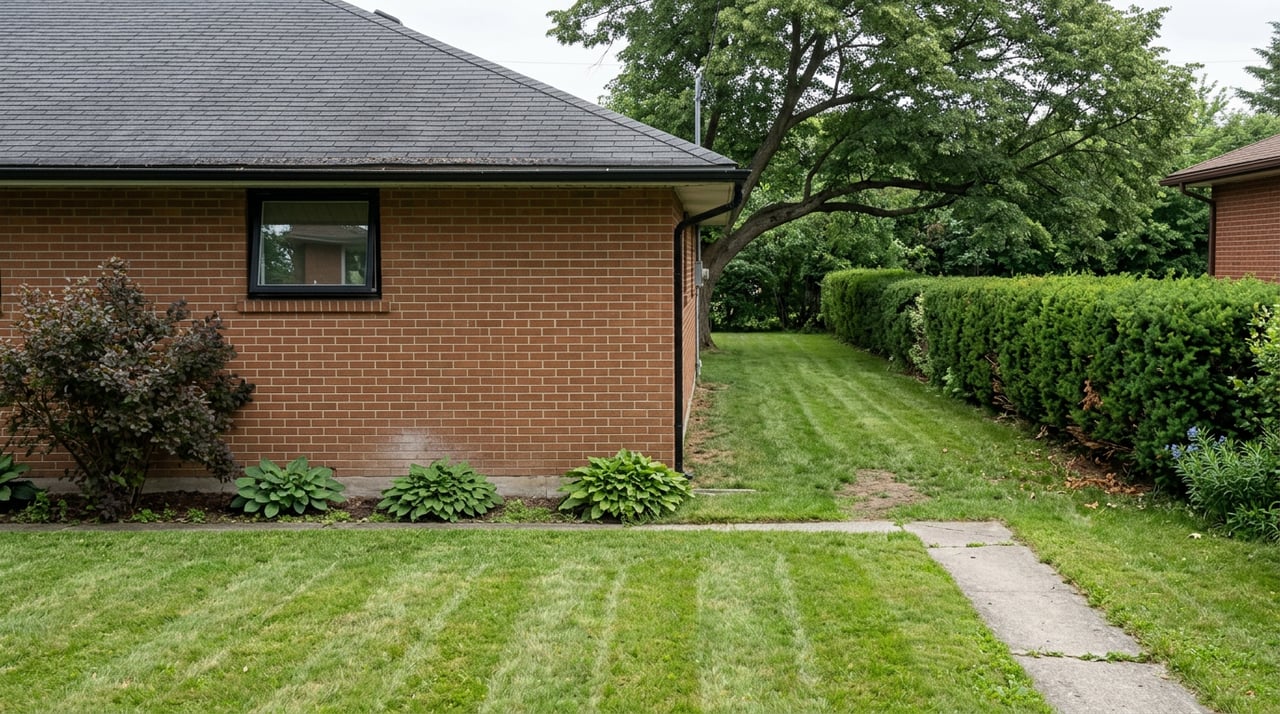
A West Oakville listing that recently caught our eye described its own house almost as an afterthought: a 2-bedroom bungalow sitting on roughly six-tenths of an acre, marketed for "interim use, rental potential, or renovation option while planning construction." The agent wasn't hiding the ball. In this pocket of Oakville, that is simply an honest way to sell a house. The structure is a placeholder. The lot is the transaction.
That distinction matters more than most buyers realize when they start running numbers. West Oakville is defined, almost by name, by its stock of small post-war bungalows on generous lots giving way to custom rebuilds, and local MLS listing sheets treat it that way too, tagging the pocket with the shorthand community code "1020 - Wo West" that groups these bungalows together as a distinct inventory class rather than folding them into general Oakville detached housing. The market already understands what these homes are for. The question is whether buyers do the same math the market has already done.
The Bungalow Was Never the Product
Look at how these lots actually get marketed. One recent listing between Bridge Road and Tansley Drive offered a raised bungalow with just 1,000 square feet above grade on a 60-by-125-foot lot, pitched explicitly as something to "move into" or "invest for income or redevelopment." Another, near the cross streets of Mary and Dorval, emphasized the area’s expansive lots and custom new builds before a single interior feature came up. A third, steps from Appleby College and Lake Ontario, sold itself the same way. The pattern holds across the pocket: square footage of the existing structure is a footnote, and depth, frontage, and proximity to the water and the school corridor carry the actual pitch.
Across Oakville as a whole, that decoupling shows up in the numbers too. As of August 22, 2026, there were 72 active bungalow listings across the town with a median list price of $1,499,500. That median tells you almost nothing about square footage, finish level, or age of mechanicals. It tells you what a piece of Oakville dirt with an aging structure on it currently costs to acquire. Buyers who treat that number as a house price, rather than a land price with a temporary tenant on it, are pricing the wrong thing.
What the Build Actually Costs Once You Own the Land
The land is only step one. A 2026 cost guide from custom home builder Leedway Group puts quality construction in Oakville at roughly $350 to $575 per square foot before land, meaning a 2,500-square-foot home starts near $900,000 and climbs past $1.4 million with premium finishes, complex rooflines, or a walkout basement. Those figures cover core construction only.
| Cost layer | What it covers | Typical range |
|---|---|---|
| Core construction | Structure, mechanicals, standard finishes | $350 to $575 per square foot |
| Architecture, engineering, permit drawings | Design and stamped drawings for permit submission | 8 to 15 percent of construction cost |
| Contingency | Site surprises found once excavation starts | 10 to 15 percent held back |
| Site development | Grading, tree protection, utility upgrades on mature lots | Can run well into six figures |
That last line is where West Oakville's mature, tree-lined lots quietly add cost that a builder working in a stripped North Oakville subdivision never sees. Grading, tree protection plans, and utility upgrades on an established lot with sixty-year-old trees are not optional extras. They are part of what makes the lot buildable at all.
The Two Calendars Nobody Puts on the Listing Sheet
Here is the part of the math that a spreadsheet cannot fix, because it isn't a cost. It's a sequence, and it runs on two calendars that have nothing to do with your contractor's schedule.
The first calendar belongs to the trees. Oakville's Private Tree Protection By-law requires a permit before removing any tree measuring 15 centimeters or more in diameter at breast height, and if the removal is connected to a development application such as a teardown rebuild, the town requires an arborist report from a certified and licensed arborist as part of that application. Tree inspections are limited to roughly May through October, while trees are in leaf, according to Oakville's Development Engineering Permit Application guidance.
The second calendar belongs to the ground itself. Oakville's Development Engineering Permits page says any teardown rebuild in Oakville needs a Development Engineering Permit for site alteration, the same permit category that covers grading, excavation, and lot alteration. Once work is done, a Lot Grading Certificate has to be filed by a professional engineer, Ontario land surveyor, or landscape architect who was physically on site within the past 30 days, and the town will not release your permit security until that certificate is filed. Grading inspections, in turn, cannot happen while the ground is snow covered.
Put those two rules next to each other and the practical sequence for a West Oakville teardown looks like this:
- Submit the tree removal permit application, with an arborist report if the removal is tied to your development plans, understanding that inspections depend on trees being in leaf.
- Apply for the Development Engineering Permit covering site alteration and grading, separate from your building permit.
- Complete construction and grading, then have a professional file the Lot Grading Certificate confirming they inspected the site within the prior 30 days.
- Pass final inspection and receive your security release,
None of that sequence cares what month your contractor is available. It cares what month the trees are in leaf and whether the ground is frozen. Some West Oakville and adjacent lots sit near creek corridors. Lots close enough to a regulated feature can trigger a Conservation Halton review on top of the town's own process, which means a third authority with its own timeline before you can break ground.
Buyers who close on a teardown lot in November and expect shovels in the ground by January are not fighting their builder's calendar. They're fighting the tree canopy's calendar, and it doesn't move for anyone.
Reading the Current Market Correctly
This friction is easier to absorb right now than it has been in recent memory, because the broader Oakville market is handing land buyers more room to negotiate, not less. As of August 2026, Oakville's detached-home sales-to-new-listings ratio sat at 33 percent with 6.1 months of inventory, unchanged from July and consistent with a market where supply has room to breathe. Year over year, sales were up 32.6 percent and active listings were up 31.6 percent, while average price was down 7.6 percent and median price was down 3.2 percent over the same period.
That combination, more transactions alongside softer pricing, is the kind of number that contradicts the obvious story. A hot market with rising sales should usually come with rising prices. Here it hasn't, which tells a land buyer something specific: there are more lots changing hands, and sellers are not commanding the premiums they were a year earlier. In the 28-day window ending June 27, 2026, Oakville saw 906 new listings hit the market townwide, with homes that sold moving in a median of 27 days. Inventory is moving, but it isn't scarce, and buyers negotiating a teardown lot right now have more leverage on the land price than they've had in the recent past.
The lesson is not to rush the permit sequence to make up for a soft market. It's the opposite. With inventory this available, there is little reason to close on a lot in a season that forces you to wait through a full leaf cycle before your arborist report can even be finalized. Patience on the purchase timing pays twice: once in the price you negotiate, and once in whether your construction calendar actually lines up with the town's.
Frequently Asked Questions
Does every West Oakville lot require Conservation Halton review? No. That review applies specifically to properties near regulated features such as creek valleys, floodplains, or slopes. Confirm jurisdiction directly with Conservation Halton and the town before assuming a lot is or isn't affected.
Can I remove trees before my purchase closes to save time? No. The Private Tree Protection By-law applies to the property regardless of pending ownership changes, and removing a protected tree without a permit exposes the current owner, not a future buyer, to enforcement.
What's the fastest realistic path from closing to construction? Closing in early spring gives you the best chance of completing the leaf-season arborist inspection and the frost-free grading inspection within the same building season, rather than splitting your project across two calendar years by accident.
If you're weighing a West Oakville bungalow against the cost and timeline of a custom rebuild, the numbers above are the starting point, not the finish line. Every lot carries its own tree canopy, its own proximity to regulated features, and its own realistic build sequence. Raymond Pace and the Pace Team walk West Oakville buyers through that math on a specific address before an offer goes in, not after. Book a Private Consultation to find out what your particular lot actually costs to unlock.
This article is general information, not legal, tax or financial advice. Consult a qualified professional about your situation.